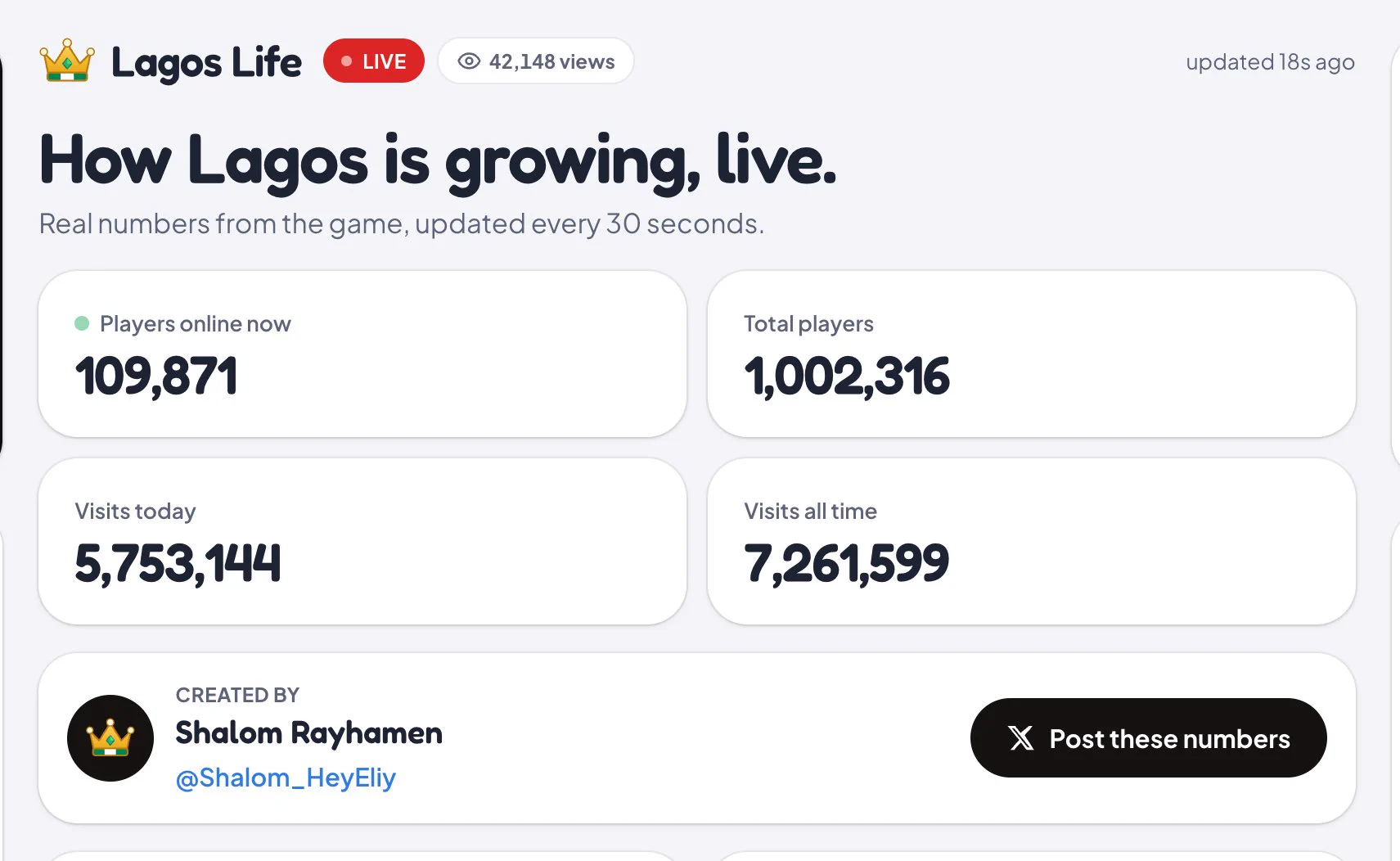
LagosLife’s official statistics page credits Shalom Rayhamen (@Shalom_HeyEliy). An interview published by Condia on 6 October names the developer as Shalom Mathew and describes the emerging team. [1] [2]
The short answer to the business question is that a free entrance can support paid activity around the game. LagosLife offers advertising placements, has reported brand integration, and sets out optional purchases of virtual currency. These are different revenue channels, and knowing that they exist does not tell us how much profit each one produces.
Who is behind LagosLife?
Condia describes a UK-based Nigerian developer with almost ten years of software experience, using AI for development, bug investigations and feature requests. [2]
The original launch post supplies a simpler starting point: a love of The Sims 3 and a spark from Lagos Run, the Nigerian danfo browser game. The idea was to put a life simulation in a world shaped by familiar experience. That is the creator’s explanation of the inspiration; it should not be confused with an official connection to The Sims franchise. [3]
Is it one person or a development team?
At the time of the interview, Condia reports a core team of fewer than six people, plus support spanning operations, marketing, product and customer service. It does not publish a complete staff list. The available picture is a founder-led project with a small team taking shape around it. [2]
That change matters for the business. A game with a growing social world needs more than new features: somebody has to handle support, resolve problems and keep routine work moving. Team size alone cannot tell us whether the operation can meet demand, but the move to share that work is an important part of this story.
Revenue route one: sell space in the virtual city
The official ad-booking page offers city billboards, lagoon Sea Plots, airport boards and space on the statistics page. Advertisers supply an image and a destination link; the page describes paid placements that send visitors to that link when selected. The quoted prices below are the public listing checked on 6 October, not evidence of how many bookings sold. [4]
| Placement | Listed price | Listed duration |
|---|---|---|
| City billboard | ₦250,000 each | 7 days |
| Lagoon Sea Plot | ₦18,000 each | 7 days |
| Statistics-page placement | ₦150,000 | 7 days |
| Airport board | ₦500,000 | 7 days |
The ad page says city screens rotate creatives in ten-second turns. Prices can change quickly, so the booking page is the place to check a current quote. A listed price and available placement establish an offer; they do not establish campaign delivery, sales volume or advertising effectiveness. [4]
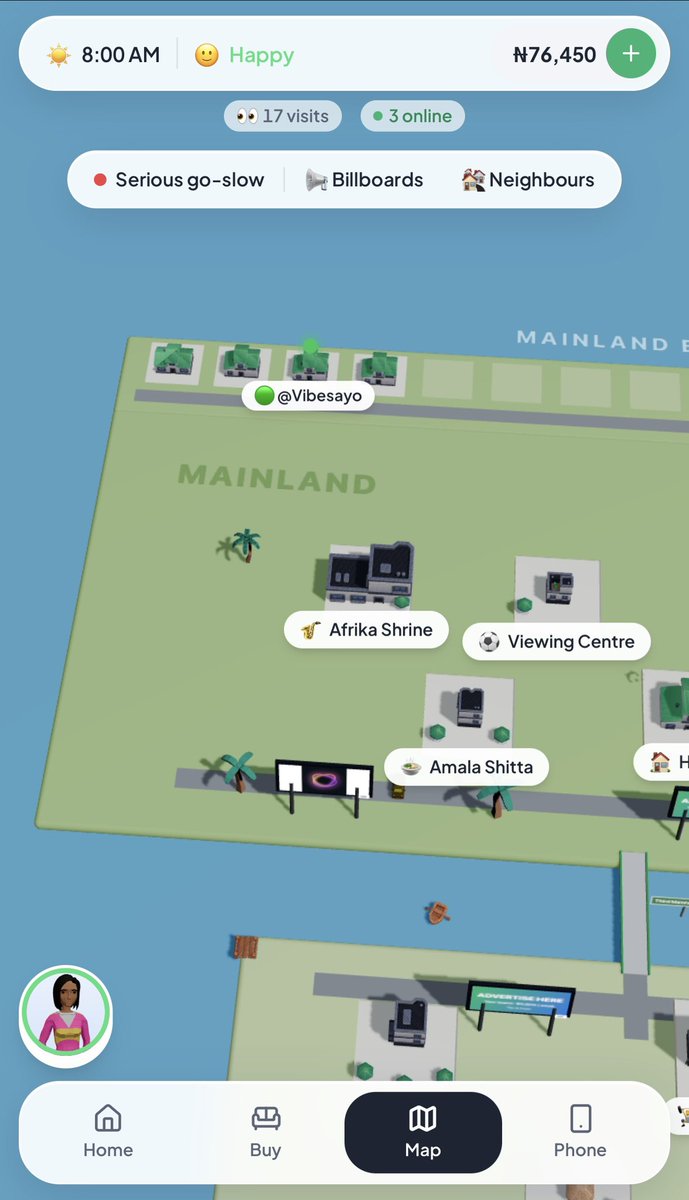
The commercial logic is easy to follow: the places a player passes can also be places where a business pays for attention. What makes the idea interesting is the setting. An ad can sit inside a route or meeting place rather than beside an unrelated article. Whether that produces worthwhile results for an advertiser needs campaign evidence, not just a crowded map.
Revenue route two: brands can become part of the experience
Condia reports a Chowdeck integration in the simulated smartphone, but gives no deal value. [2]
A phone app, a venue or an event could create a richer placement than a static image. That is the business possibility, not a claim that every location is sponsored. LagosLife’s official disclaimer says that the presence of a real brand does not by itself prove a partnership. A familiar logo in a screenshot is therefore insufficient evidence that its owner paid to appear. [7]
Revenue route three: optional player purchases
The official terms allow players to buy Game Naira with real money. They describe it as a digital game benefit rather than withdrawable cash. This establishes the purchase model in the rules; we did not complete a checkout, and the public material reviewed does not show what share of revenue comes from purchases. [5]
The distinction changes how to read a spectacular in-game fortune. A character’s fictional balance is not the developer’s revenue, and neither is automatically a player’s real money. When discussing the business, keep the payer, the payment and the in-game result separate.
How much has LagosLife made?
On 5 October, Rayhamen posted that LagosLife had earned $46,900 in revenue in four days. That is a dated, public statement by the creator. It is not an independently audited result, and the post does not break the total down into advertising, partnerships and player purchases. [6]
Revenue is also different from profit. Without figures for running costs, staff, payment fees and other expenses, there is no sound way to calculate what remains. Multiplying a dramatic launch period into a monthly or annual forecast would add another unsupported assumption: that the initial pace will continue.
The next business question is whether LagosLife can keep people returning while giving advertisers and paying players reasons to stay satisfied. More paid space is not automatically a better game. The balance between a lively city, useful revenue and an enjoyable experience will decide whether the first burst of attention becomes a durable operation.